

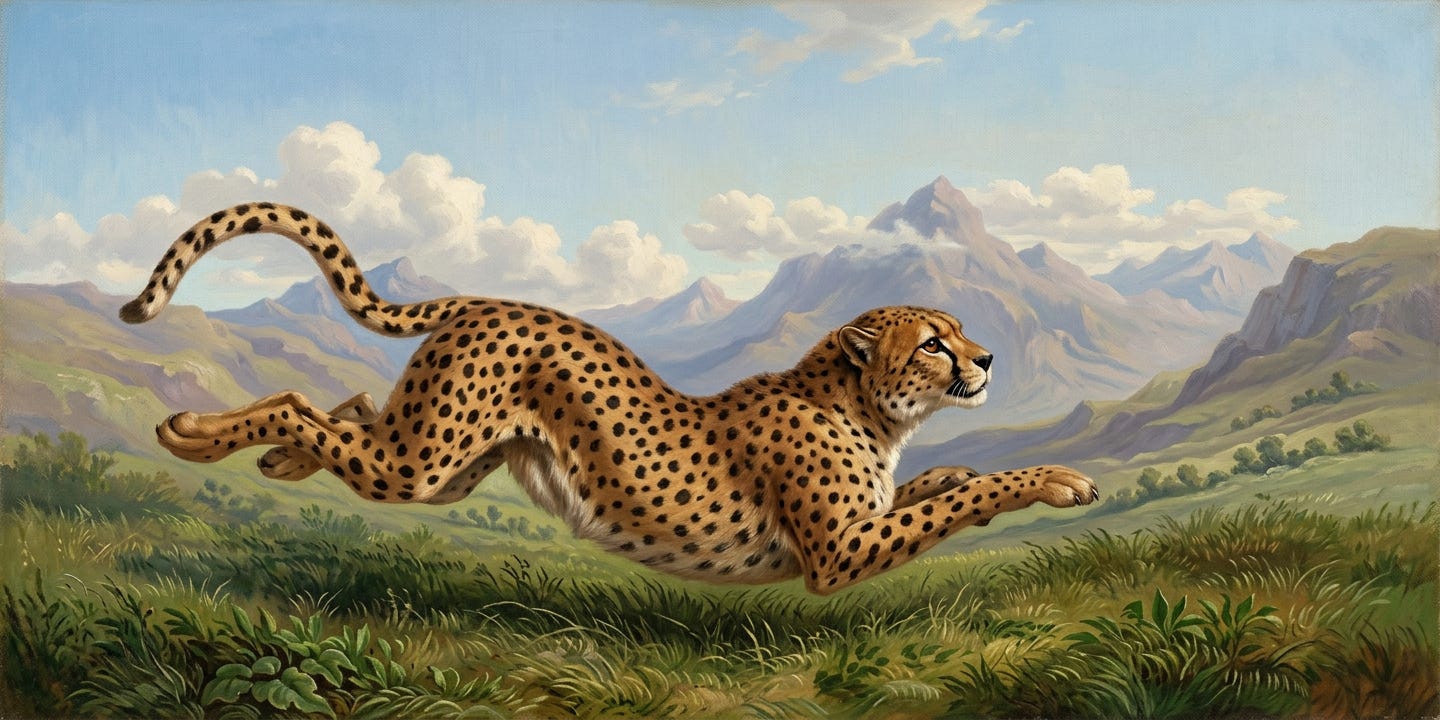
The heat shimmers over the grasslands of sixteenth-century Hindustan, and the air carries the low, insistent pulse of drums. Across the open plain a procession moves, kicking up a fine golden dust that hangs and glitters in the sun, and at its very heart, swaying gently on the shoulders of servants, comes a palanquin. This pole-borne sedan chair is the sort of conveyance ordinarily reserved for princes and ministers, for men of rank whose feet are thought too precious to touch common ground. Yet the figure riding within it now is no minister at all. It is a cat. A cheetah reclines there in state, its sleek body dappled with dark spots, its amber gaze sweeping across the passing country with the serene detachment of royalty, while the drums beat before it to announce its coming. This was no everyday sight, and yet neither was it rare in the court of the Mughal emperor Akbar, a ruler who loved the cheetah as perhaps no sovereign in all of history ever has, and who lifted these swift and elegant creatures into a place in his world scarcely distinguishable from that of his own courtiers.
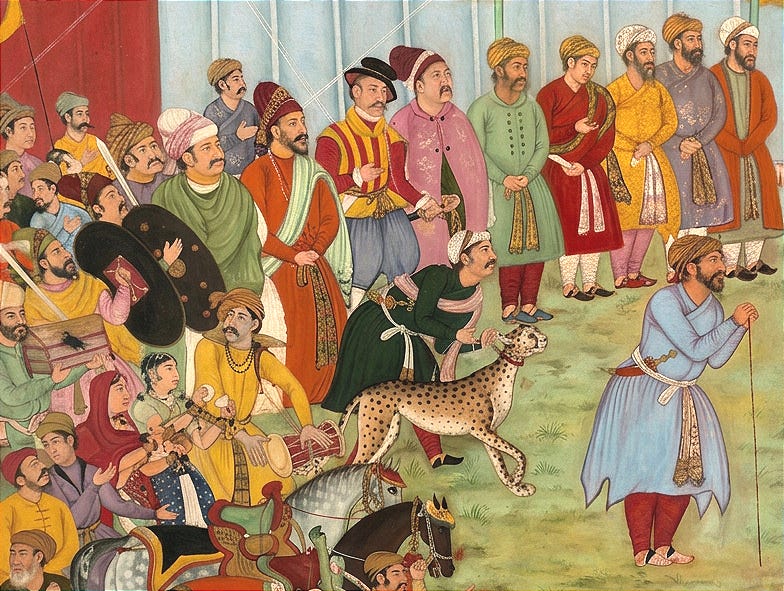
The scale of that devotion almost defies belief. Across a reign that stretched from 1556 to 1605, Akbar gathered a staggering nine thousand of these cats, and at any single moment his establishment might hold as many as a thousand of them, a living treasury of speed and grace assembled beneath one imperial roof. We know this because his court historian, Abu’l Fazl, recorded the emperor’s fascination again and again in the pages of the Akbarnama and its companion volume, the Ain-i-Akbari, those great chronicles from which the Indian historian Divyabhanusinh would later draw for his 1995 study, The End of a Trail: The Cheetah in India. The passion took hold early. Akbar’s very first cheetah arrived as a gift in 1555, soon after he came to Hindustan, and from that moment the fascination never once loosened its grip. He sorted his thousands of cats into eight distinct classes, and rather than treating them as interchangeable instruments of the chase, he gave each one a name and assigned it a rank, as though every animal were an officer of his court, waiting quietly in the wings for its turn to serve.
Yet behind all this ceremony lay a stubborn and vexing problem, one that shaped everything about the way the Mughals kept their cheetahs. The animals simply would not breed in captivity. Akbar’s own son and successor, the emperor Jahangir, set the matter down plainly in his memoirs, observing that it was by then an established fact that cheetahs, held in unfamiliar places, would not pair off with a female. This single quirk of nature carried enormous consequences, for it meant that every last cheetah in the imperial establishment, all nine thousand of them across the long years of Akbar’s reign, had to be taken from the wild, drawn out of the open country where each had first learned to run. And even the catching demanded uncommon skill and a fine sense of timing from the shikaris, the huntsmen who caught and trained them. A cheetah could not simply be snatched as a helpless cub and raised by human hands, for taken too young it proved useless for the hunt, having never learned from its own mother the hard and intricate craft of the kill, the closing of the final distance, the pulling down of fleet and frightened prey. The animal had to be schooled by nature before any human trainer could hope to refine it, its wildness the very thing that made it worth the taking.
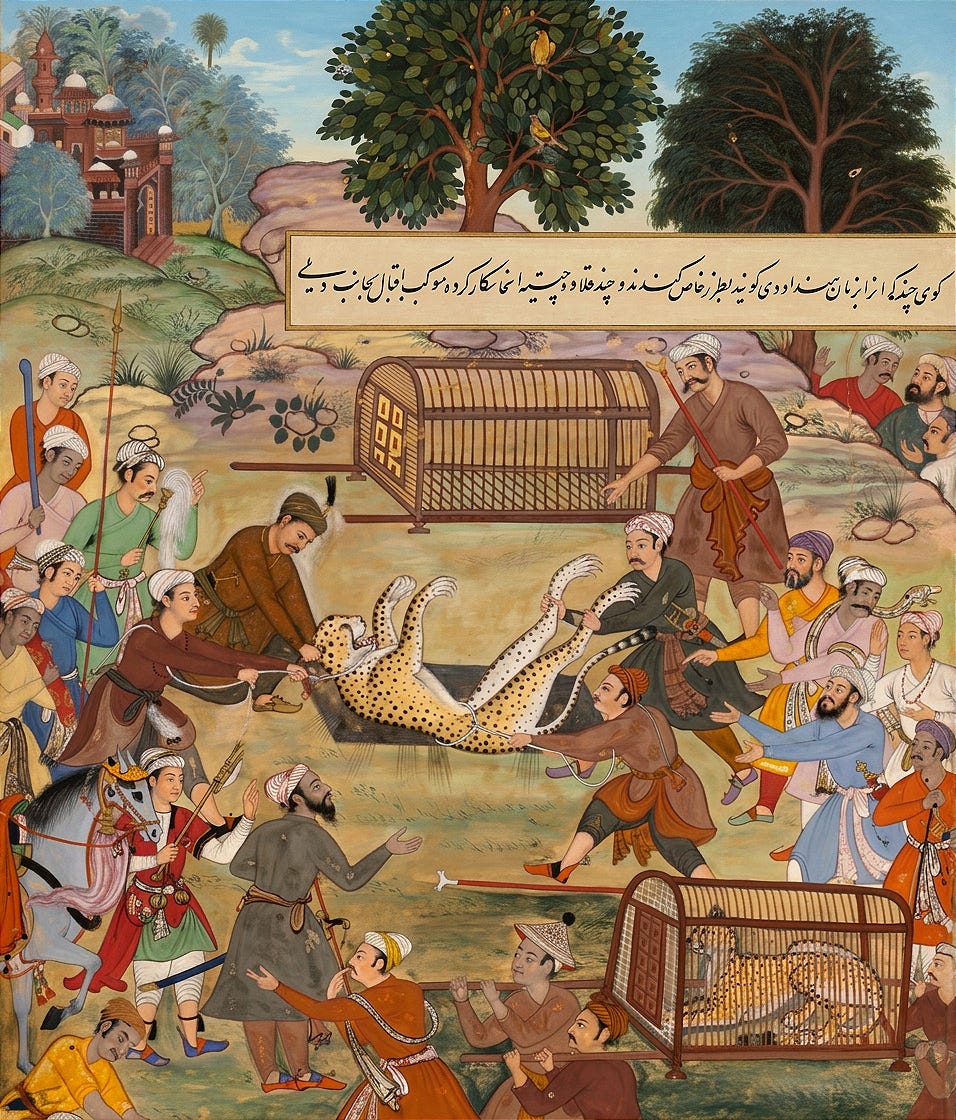
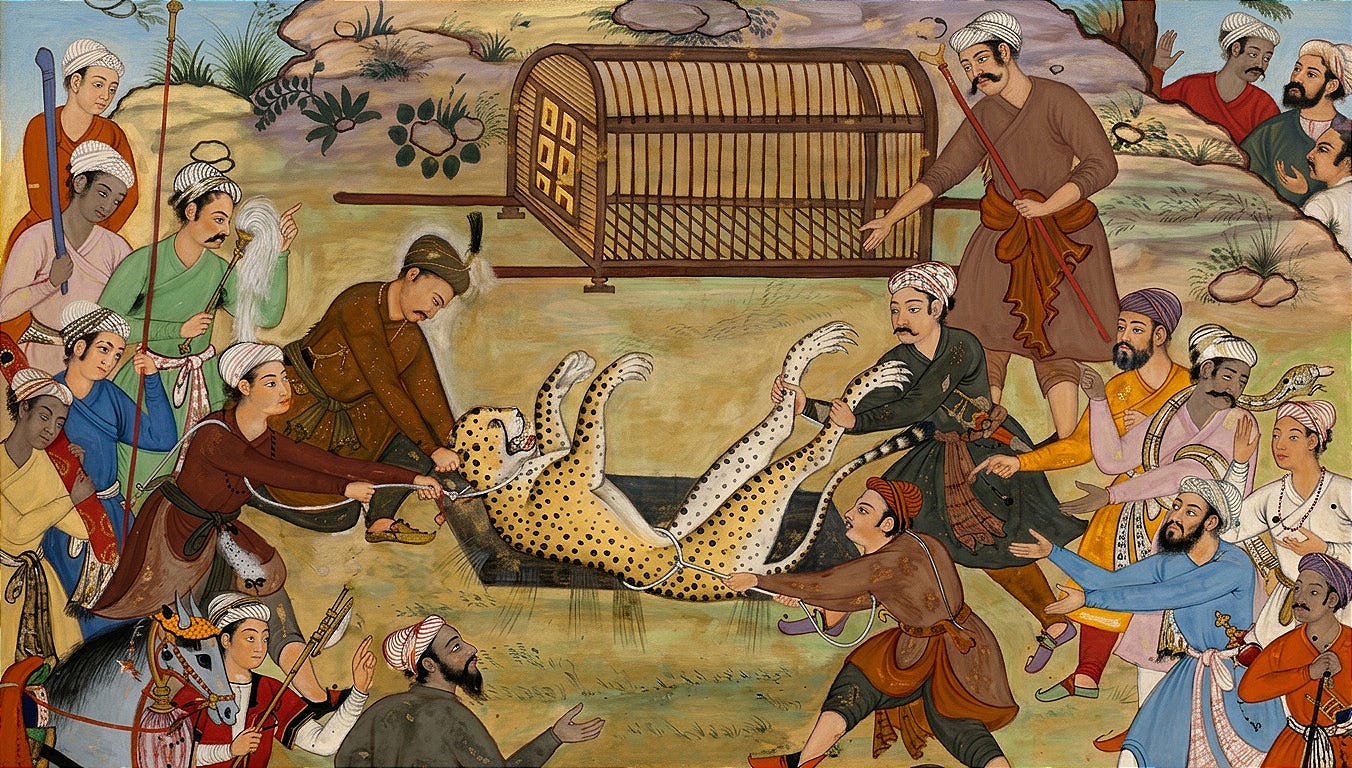
So intense grew the demand for wild cheetahs that entire districts, famous across the land for the numbers that roamed them, were set aside as royal capture grounds, and their names still fall like a litany of the hunt across the map of northern India, Jodhpur and Jhunjhunu among the deserts of Rajasthan, Bathinda in the Punjab, Hisar out on the plains of Haryana. It was to the sheer practical difficulty of the capture itself that Akbar turned his restless and inventive mind, and the solution credited to him tells us as much about the character of the man as about the sharpness of his cleverness. Hunters before him had dug deep pits into which a racing cat would tumble, all too often breaking its slender legs in the sudden violence of the fall. Akbar imagined something gentler and far more ingenious, a shallow pit fitted with an automatic trap door that swung quietly shut behind the animal the very instant it dropped inside. The brilliance of the thing lay entirely in its restraint. There was no long and bone-shattering plunge, no injured beast to be nursed painfully back over months, only a cheetah sealed in whole and unharmed, ready to be gentled and trained rather than mended. And there is something quietly astonishing in the picture of it, an emperor at the very summit of his power stooping to consider the exact depth of a hole in the ground, all so that a wild creature might be spared a broken leg. In that small mercy we glimpse the peculiar tenderness that ran, unexpected and unmistakable, beneath the whole Mughal love of the chase.
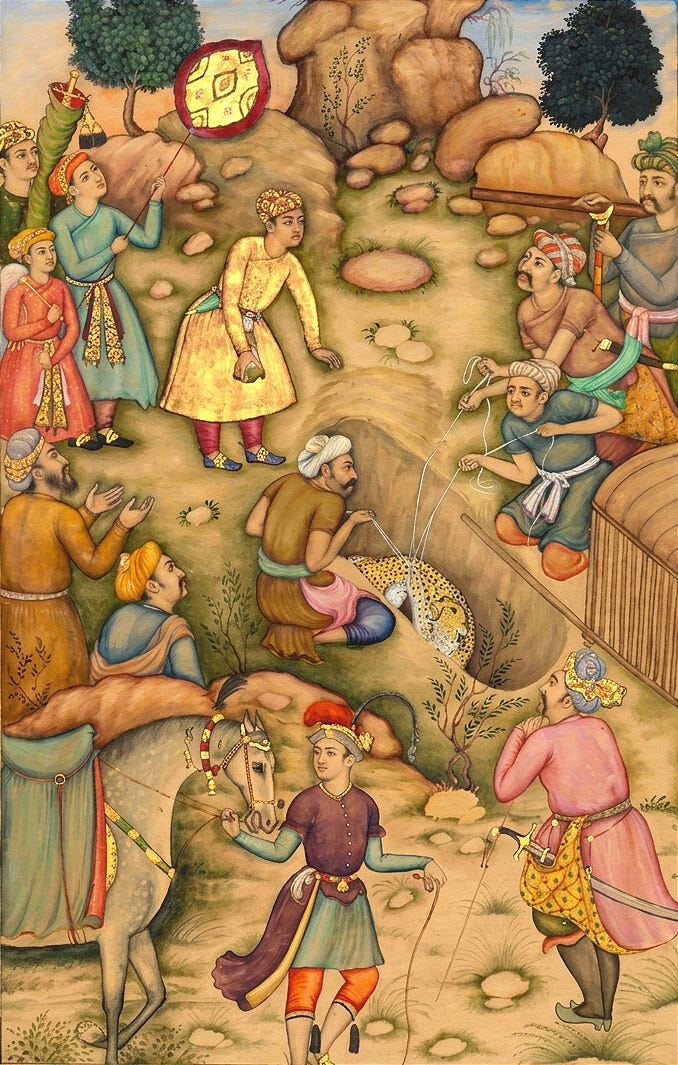
All of this care, all of this ingenuity, found its reward at last in a single unforgettable moment, one that Abu’l Fazl thought worthy of preserving forever in the pages of the Ain-i-Akbari. It concerns the emperor’s most cherished cheetah of all, a cat whose very name, Chitr Najan, proclaimed its glory. Picture the scene as the chronicle hands it down to us. The hunt is spread wide across the open country, the emperor mounted and watching, the air taut with anticipation as the cats are slipped loose after a herd of blackbuck, those fleet antelope whose great bounding leaps can carry them clear over the heads of their pursuers. In the fury of the chase the quarry reaches the lip of a broad ravine and flings itself across the gulf, trusting the empty air to break the cheetah’s charge as it had broken so many hunters before. But Chitr Najan does not hesitate at the brink. To the astonishment of every man watching, the cat gathers itself and leaps the ravine entire, rising, in Abu’l Fazl’s celbrated phrase, to a height of a spear and a half as it soars across the void and runs the blackbuck down on the far side.
Akbar, who prized excellence in a living creature as fiercely as ever he prized it in his ministers and his soldiers, could not let such a feat pass unhonoured. He raised Chitr Najan to the first rank among all the thousands of cheetahs in his establishment, making the cat the head of them all, and he decreed that from that day forward a drum should sound before it whenever it was carried out to the hunt. Divyabhanusinh points to precisely these marks of favour, the roll of the drum and the collar set with precious stones catching the hard plains-light, as the surest measure of how exalted a place the cheetah had won within the emperor’s court. And so we are left holding the image of it, an animal drawn from the wilderness by an emperor’s own gentle ingenuity and then lifted up, for one breathtaking moment of impossible grace, into something very nearly a prince of the realm, riding out across the golden plains beneath the beating of drums that once heralded only kings.