

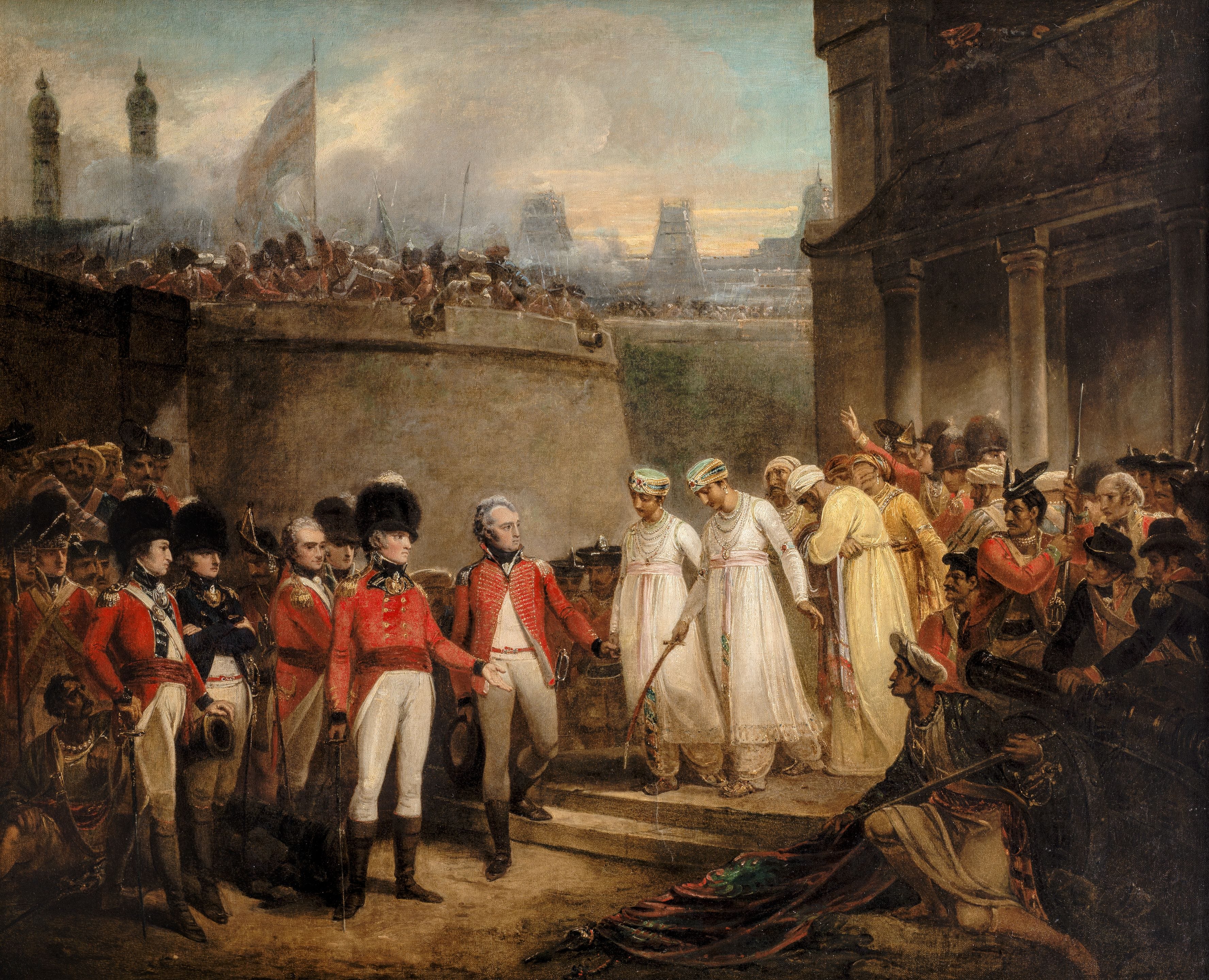
There are moments in history when the fate of an entire kingdom folds itself into a single, carefully staged scene, and the morning of 26 February 1792 was one of them. On an island in southern India, inside a great military tent pitched within sight of the fortress walls of Seringapatam, two small boys in white muslin and red turbans were about to walk into one of the most painted, most mythologised episodes of the British encounter with India. They were the sons of Tipu Sultan, and by the end of that day they would no longer belong entirely to their father.
The world around that tent had been unravelling for weeks. Tipu Sultan’s military position had collapsed under the weight of a combined army led by Cornwallis, an army that fused British East India Company troops and British regulars with the allied forces of the Nizam of Hyderabad and the Marathas. This coalition had reached Seringapatam on the fifth of February, and in less than three weeks the fighting had effectively burned itself out by the twenty-fourth. Cornwallis, standing before Tipu’s fortified island capital, faced a choice familiar to every commander at the gates of a well-defended city: storm it at ruinous cost, or negotiate. He chose to negotiate, but he attached a condition that cut to the heart of a father’s world. Tipu was to hand over two of his sons as living guarantees, security that he would honour the coming settlement and, above all, pay the staggering indemnity of 330 lakhs of rupees. The formal peace, the Treaty of Seringapatam, would not be signed until the eighteenth of March, which means the children were surrendered first, as collateral for a bargain that had not yet been struck.
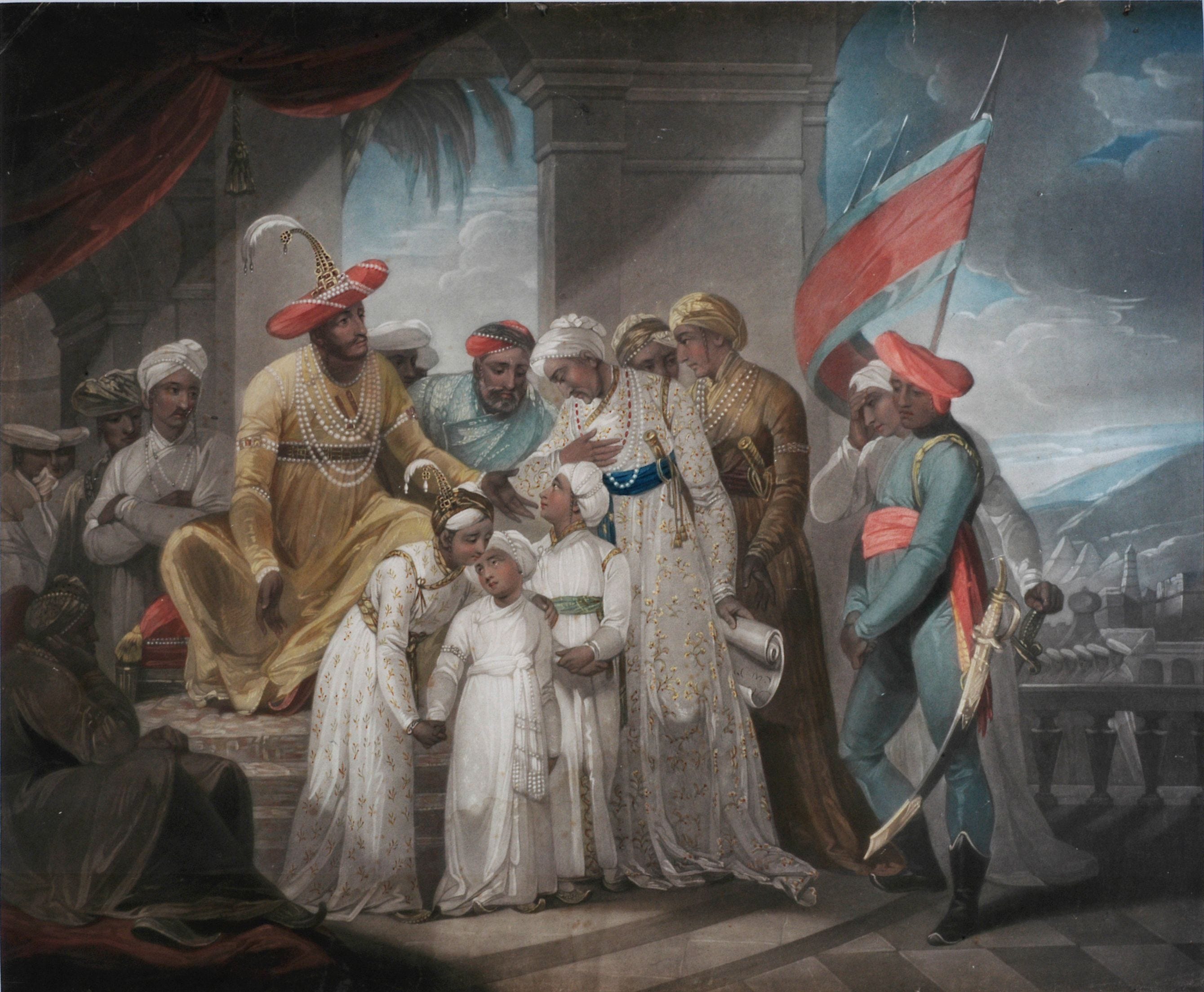
What makes this morning so vivid to us across the centuries is that men who were there wrote it down. Major Alexander Dirom and Lieutenant Roderick Mackenzie both published accounts of the campaign soon afterward, and the painter Robert Home actually travelled with Cornwallis’s expedition, sketching on the spot, which is precisely why his rendering of the scene is treated as the most trustworthy visual record we possess. Through their eyes we can still watch the two princes, Abdul Khaliq, the elder, and Muiz-ud-din, the younger, though the sources cannot quite agree on how old they were, some placing them at roughly eight and ten, others at seven and eleven, a small uncertainty that lives inside the original writings themselves rather than in anything added later.
Dirom’s description lets us stand at the tent’s entrance. On that morning the two boys were carried out of the fort on elephants, moving through great pomp as gun salutes thundered from both the Mysorean side and the allied lines. Cornwallis, surrounded by his staff and senior officers, met the children as they dismounted, embraced them, and led them inside with one boy’s hand in each of his own, seating them on either side of himself. They were dressed for the eyes of history, in long white muslin gowns and red turbans, several rows of large pearls looped around their necks, ornaments of ruby and emerald ringed with brilliants hanging from them, and sprigs of pearls glinting in their turbans. It was an image of princely splendour and princely vulnerability held together in the same small figures, and the British artists who came after would linger over exactly that tension.
Then came the line that would echo through nearly every painting made of the event. According to Dirom, Tipu’s chief negotiator, the head vakeel Ghulam Ali Khan, turned to Cornwallis and spoke words designed to be remembered, telling him that these children had been that very morning the sons of the Sultan his master, that their situation was now changed, and that they must look up to his Lordship as their father. Whether or not the sentiment matched the true feeling of the Mysorean side, the declaration handed the British the exact frame they wanted, the image of a conqueror transformed into a benevolent guardian, and it became the emotional pivot on which artist after artist, including Henry Singleton, would build their canvases.
The story did not end at the tent. The princes were not kept at Seringapatam but sent on toward Madras, pausing along the way to visit the tomb of their great-grandfather Fatteh Muhammad at Kolar, before entering Fort St. George on the thirtieth of May 1792 in a formal procession greeted by a garrison salute and full military honours. There they were housed in a fine residence and placed in the care of Captain, later Colonel, Doveton, remembered as a kindly guardian, while Tipu’s vakils Ghulam Ali Khan and Ali Raza Khan stayed close to them. Their captivity was comfortable and remarkably public, a spectacle in its own right, and they were taken to a performance of Handel’s Judas Maccabaeus and to amateur theatricals, while on the twenty-ninth of June 1792 Lady Oakley, wife of the Governor of Madras, threw a grand ball in Cornwallis’s honour where the two boys were once again seated on either side of him, the living tableau that painters were, at that very moment, busy translating into oil.
For nearly two years this arrangement held, until Tipu at last paid the indemnity that had bought his sons their freedom and the boys were returned to him, an account drawn from the Madras records placing that homecoming on the twenty-seventh of February 1794, after almost two years within the walls of Fort St. George. Yet the ceremony of embraces and pearls had secured no lasting peace. The humiliation of surrendering both his children and half his kingdom sank deep into Tipu Sultan, hardening an enmity toward the British that would carry forward to the Fourth Anglo-Mysore War and to his own death in the storming of Seringapatam in 1799, the fortress and the family bound together to the very end.