

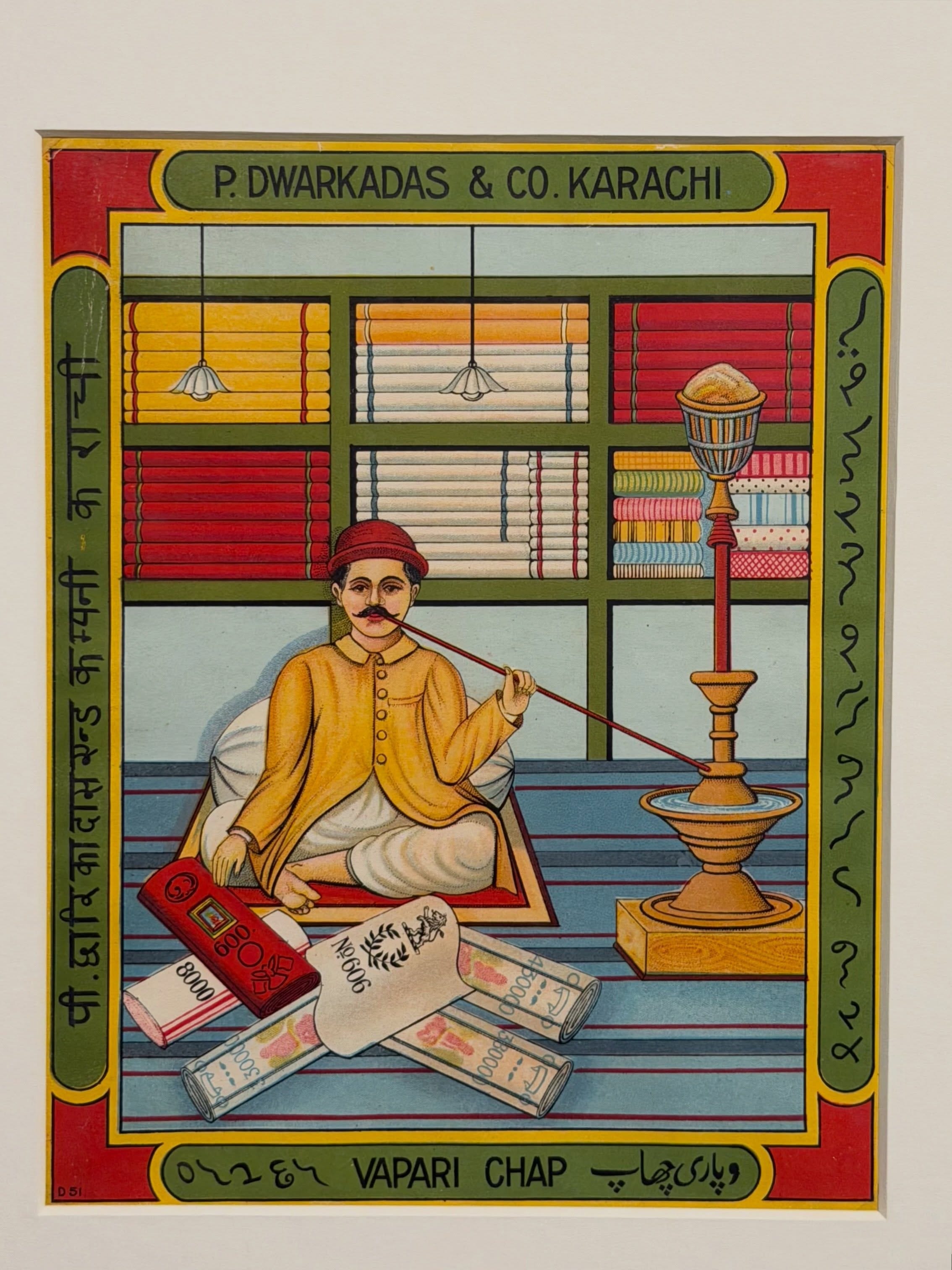
There is a kind of object historians overlook precisely because it was never meant to survive—cheap, functional, discarded by the thousand. Yet when such a thing endures, it often tells us more than the marble and bronze we so dutifully preserve. The tika chaap—the small, chromolithographed paper label once glued to bolts of Indian cloth—is exactly such an object. To understand it, one must grasp the strange geography that produced it: raw cotton picked in the Deccan and Gujarat, shipped to the mills of Lancashire, woven in Manchester, and sent thousands of miles back to be sold in the very land where its fibre had first been grown. The label sat at the end of this long circuit, at the precise point where a foreign commodity had to persuade an Indian buyer.
Herein lies the fascination. A Lancashire mill owner knew nothing of the visual grammar of a customer in Surat or Madurai; he could not stamp his cloth with a British crest and expect it to sell. The bale had to speak a language the bazaar could read. And so the chaap became an act of cultural translation—an English commercial impulse forced to borrow an Indian vocabulary of images. Lakshmi on her lotus promised prosperity to the household that bought the cloth. A maharaja lent the borrowed prestige of a court. An elephant seized the eye; a steamship, trailing its improbable ribbon of smoke, whispered a promise of modernity. Each was a small argument, assembled by men who had never heard the word “branding” yet grasped its essence completely: that we buy not objects, but the feelings we attach to them.
What makes the story wholly human is what happened next. These labels were designed to be discarded, yet people kept them—peeling them away with care, pressing them into scrapbooks, and, most tellingly, setting the images of Lakshmi and Saraswati upon their household shrines, where a commercial label became an object of genuine devotion. A picture printed in Manchester to sell muslin ended its life receiving prayers in a home on the Gangetic plain. The buyer, it turns out, was no passive dupe; he took what the empire offered and remade it on his own terms. The empire designed the label, but India decided what it would become.


