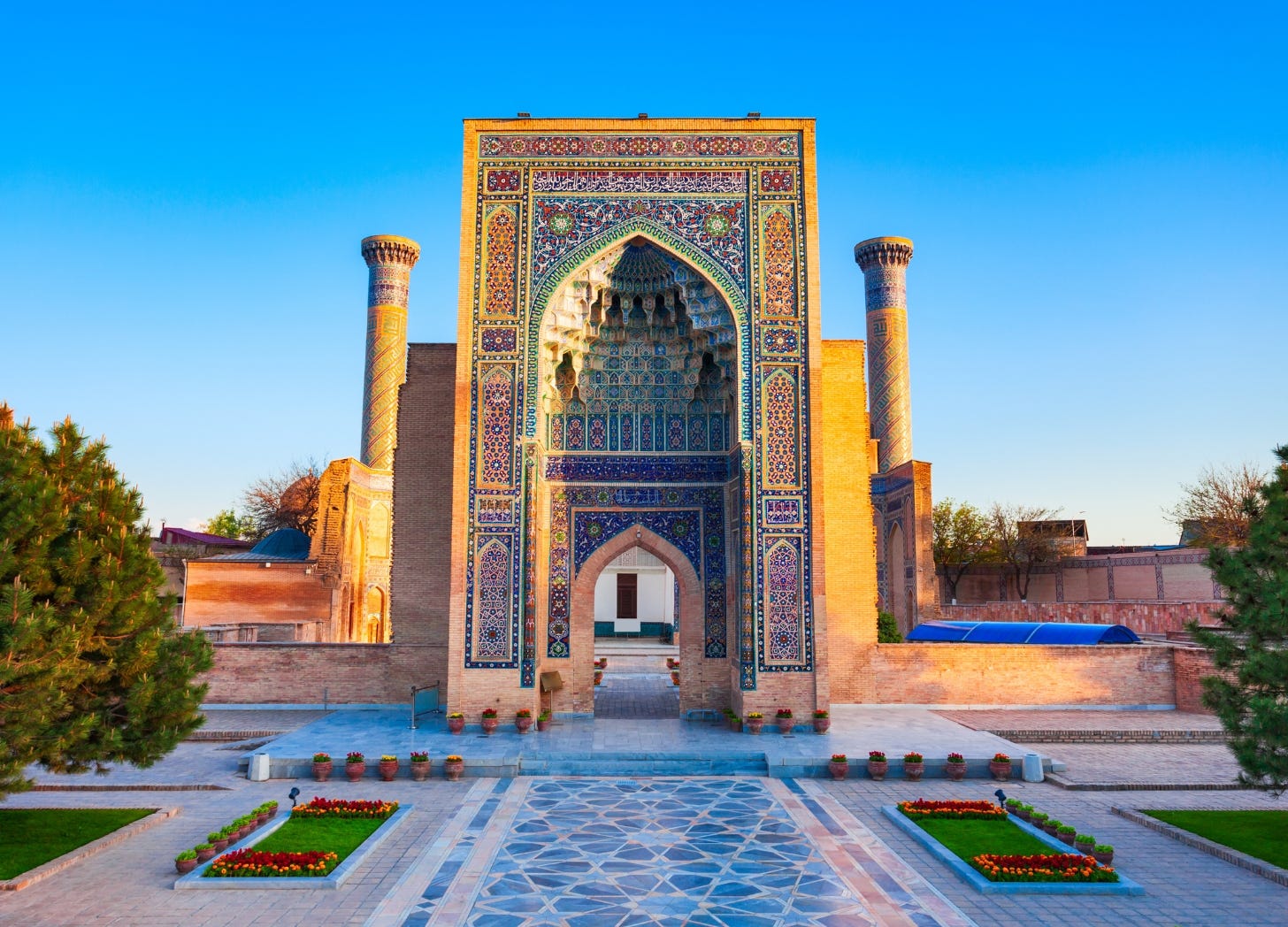
Some cities you visit. Samarkand you feel—in the way the afternoon light sets its turquoise domes glowing, in the hush that falls when you step beneath a gilded ceiling, in the strange thrill of standing where Alexander the Great, Genghis Khan and Amir Timur each once stood. This city of well over half a million people sits at one of the great crossroads of the world, where merchants, monks, soldiers and scholars once passed on the long roads linking China, Persia, India and the Mediterranean. Everyone came, everyone left something behind, and the result is a layered, dizzying place: ancient Afrosiab to the northeast, the leafy Russian quarter to the west, and the Timurid heart beating in between. Samarkand isn’t really one city—it’s several, stacked on top of each other, and half the fun is learning to read the layers.
A little history makes everything come alive. The city began around Afrosiab more than 2,500 years ago; when Alexander the Great arrived in 329 BC, he marveled that it was more beautiful than he’d imagined, then burned its citadel in retaliation for a revolt. By the 7th century it was a glittering Silk Road capital under Zoroastrian rulers, until the Arab conquest of 712 brought Islam and the city’s first mosque. In 1220 came catastrophe—Genghis Khan’s army destroyed it so thoroughly that its canals were said to run red. And yet it rose again, more brilliant than ever, when Amir Timur (Tamerlane) made it his imperial capital in 1370, hauling in the finest artisans from Damascus, Baghdad, Isfahan and Delhi. Ruthless yet passionately devoted to art and science, this single complicated man is the source of nearly everything that makes Samarkand magnificent.

If you see only one thing, make it the Registan, once the ceremonial heart of the medieval city and now a breathtaking ensemble of three madrasas around an open square. The oldest, the Ulug Beg Madrasa (1417–1420), was founded by Timur’s astronomer-grandson and decorated with stars. Facing it, the Sher Dor Madrasa (1619–1636) will stop you in your tracks with its façade of striped tiger-like beasts chasing deer beneath rising sun-faces—a startling burst of figurative art. Between them, step inside the Tilla Kari’s mosque and look straight up: the gilded ceiling seems to soar into impossible depth, though it’s really quite shallow, the most beautiful optical trick in Central Asia. Come at sunset, when the tilework shifts from teal to sapphire to gold.

A short walk away rises the vast Bibi Khanym Mosque (1399–1404), in its day the largest on earth, wrapped in legend: an architect who fell in love with Timur’s wife and demanded a kiss to finish the work, then paid with his life. Built at the very edge of medieval engineering and shaken by an 1897 earthquake, what you see now is largely a modern reconstruction—but no less awe-inspiring. Nearby, prepare yourself for Shah-i Zinda, an avenue of tombs so densely tiled it feels like walking through a jewel box. Its name means “Living King,” for a cousin of the Prophet said to have been beheaded while praying, then to have picked up his own head and vanished into a well where he lives still. Many tombs were built for Timur’s wives and sisters, each a different shade of blue—bring your camera, but also just stand and let it wash over you.
Then there is the Gur-i Amir, Timur’s own mausoleum, its ribbed melon-dome an icon of the skyline. Beneath a crystal chandelier and onyx-panelled walls lie the markers of Timur, his sons and Ulug Beg, Timur’s own a single slab of dark Mongolian jade. Here’s a story to raise the hairs on your neck: legend warned that disturbing his tomb would unleash war—and when Soviet scientists opened his grave on 22 June 1941, Nazi Germany invaded the Soviet Union within hours. Don’t miss the nearby Observatory of Ulug Beg, where, working before the telescope existed, he charted over a thousand stars and calculated the length of the year to within about a minute of today’s figure. His enemies destroyed the observatory (and his own son had him beheaded), but the great curved arc of his instrument survives, and his star catalogue was eventually published at Oxford.

Give yourself time to wander past the headline sights. Climb to the Hazrat Hizr Mosque for sweeping views from a spot once occupied by a Zoroastrian temple. Seek out the Mausoleum of Daniyar, revered by Muslims, Christians and Jews alike, where an 18-metre sarcophagus honors a legend that the prophet Daniel’s leg keeps growing, and a sacred spring and ancient pistachio tree stand nearby. For a quieter, older Samarkand, visit the surviving Gumbaz Synagogue in the former Jewish quarter—a reminder that this has always been a city of many faiths and languages, where you’ll still hear Tajik spoken widely alongside Uzbek and Russian.
Samarkand isn’t a museum; it’s a working city, and its best experiences are often the everyday ones. Dive into the Siyob Bazaar beside the Bibi Khanym Mosque, piled high with fruit, nuts and the city’s beautiful round bread. Watch silk carpets being knotted at workshops where natural dyes grow in the garden, look for suzani embroideries (pomegranates for fertility, peppers against the evil eye) and the blurred patterns of ikat silk. In the evenings, madrasa courtyards host traditional dance and the haunting classical music known as shashmaqam, said to have been born right here—and if you visit in an odd-numbered August, the Sharq Taronalari festival fills the Registan with sound. Sit down to eat in a painted 19th-century room and order a glass of the local red wine with your plov.
A last word of honest advice: much of what you’ll see has been heavily restored, especially during the Soviet era, but this doesn’t diminish its beauty—it simply means you’re looking at a city that has been loved, lost and rebuilt many times over. Think of Samarkand as overlapping worlds—ancient Afrosiab, the Timurid masterpiece, the Russian colonial town, the Soviet capital and the modern tourist city—all sharing the same ground. Don’t try to tick off every monument in a single frantic day; linger in a courtyard, get pleasantly lost in the bazaar, watch the domes change color as the sun sets. Come for the blue domes, and stay for the feeling that you’ve stepped into the beating heart of the Silk Road—because that’s exactly where you are.