

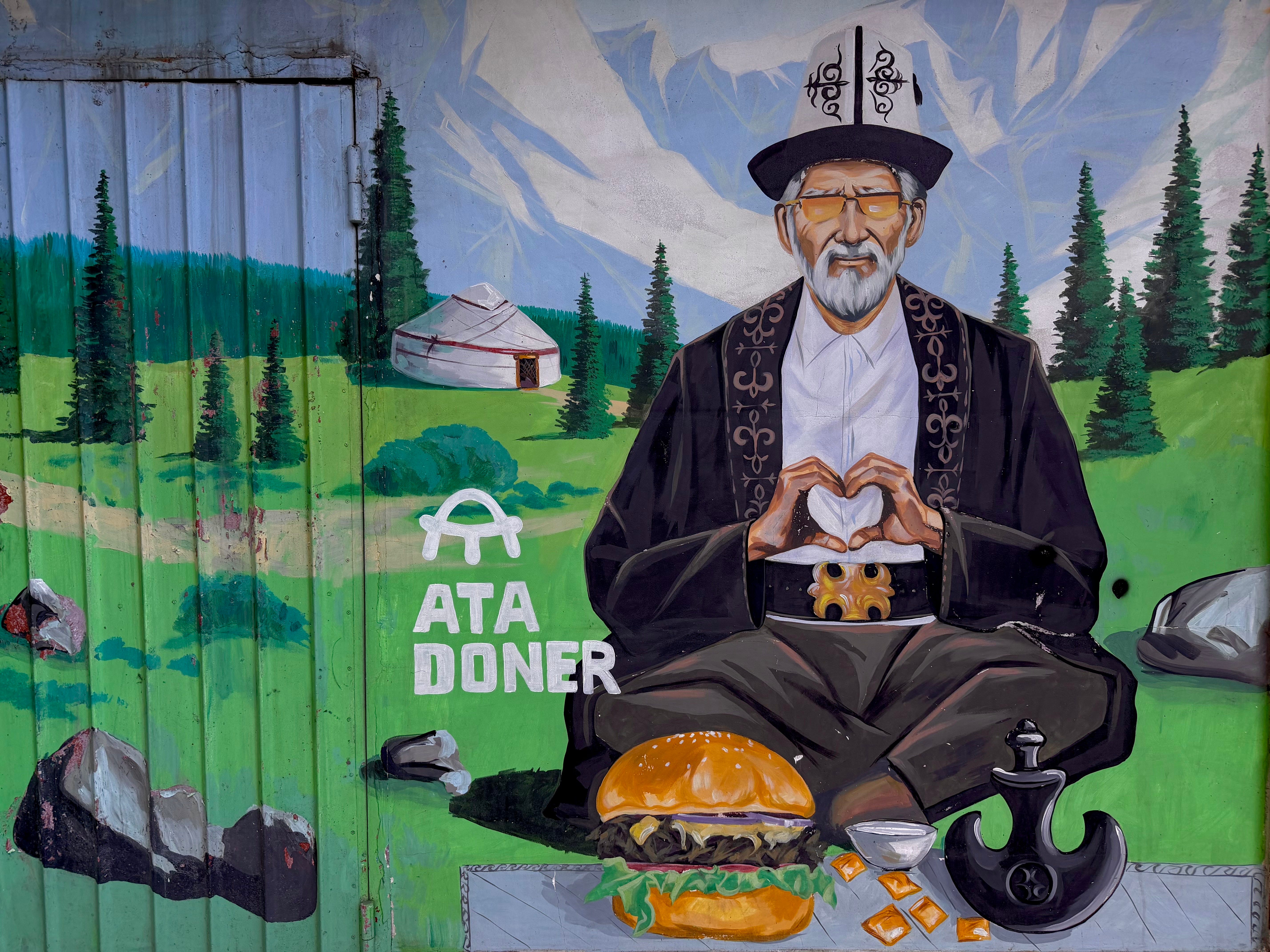
On an unremarkable street in Bishkek, the exterior wall of a neighborhood doner shop has been quietly conscripted into service as a meditation on Kyrgyz identity. Some anonymous hand—no gallery, no commission, no signature—has painted an elderly man in traditional dress, the white *kalpak* set upon his head with the dignity it has always carried, seated before a yurt beneath the snow-laden ridges of the Tian Shan. He cups his hands into the shape of a heart above an improbably large burger. The gesture is comic, certainly, but it is not merely comic. In a single image the painter has folded together the long memory of the steppe and the appetites of the contemporary city, and has done so without irony curdling into mockery. The mural is at once a joke and an act of devotion to place.
I have come to think that images of this kind repay far more attention than the passing traveler tends to give them. We are trained to look for a country's geography in its mountains and its maps, and for its history in its monuments and archives. Yet geography lives just as fully in the stories a people chooses to tell on its walls, and history endures not only in what is preserved but in what is continually re-imagined. The *kalpak*, the yurt, the encircling peaks—these are inherited symbols, and here they have been handed forward into a new grammar, made to speak to a generation that eats fast food beneath the same mountains its ancestors crossed on horseback. Heritage, this wall reminds us, is not a fixed inheritance but a living argument, revised in each generation's own idiom.
And so a humble doner restaurant becomes, without meaning to, a gallery—a place where memory, hospitality, and the ordinary texture of daily life are held briefly in the same frame. One need not travel to the museum to find the character of a nation. Sometimes it is waiting, freshly painted, at the corner where you stop for lunch.