

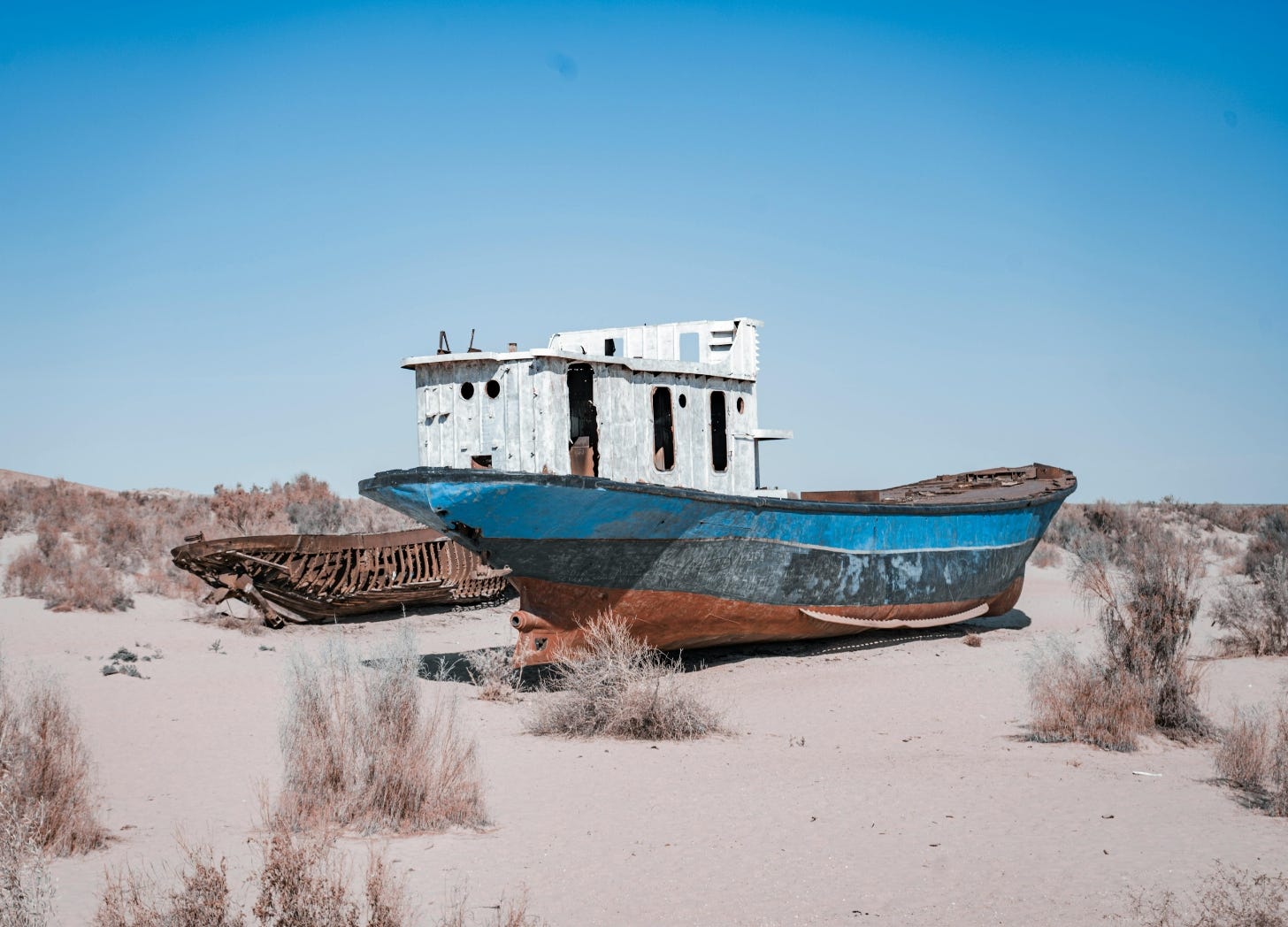
In the far northwest of Uzbekistan lies Karakalpakstan, a huge tract of desert that is, in fact, an autonomous republic. It is theoretically sovereign, with the exception of the right to secession, and political decisions affecting it are made jointly by the Uzbek government and the Karakalpak legislature in the republic’s capital, Nukus. Two thousand years ago, this was a fertile agricultural region, a far cry from the desert it has become after centuries of gradual climate change. Its indigenous inhabitants, the Karakalpaks, were nomadic herders and fishermen who fished not only in the rivers but also in the southern parts of the Aral Sea.

The territory was nominally part of the Khanate of Khiva before being ceded to the Russian Empire in 1873. The Soviets first regarded it as an autonomous part of Kazakhstan, then, from 1936 onwards, as an autonomous state within Uzbekistan. Today Karakalpakstan has a population of 1.8 million, of whom a third are ethnically Karakalpak, a third are Uzbek, and the rest are Kazakh (300,000) and other minorities. The Karakalpaks are ethnically Turkic, with a language close to Kazakh. They are notably secular, eating pork and reputedly making Uzbekistan’s finest vodka.
There are two compelling reasons to travel out into this Wild West of Uzbekistan. The first is to bear witness to the environmental disaster of the Aral Sea. The second is to wonder at how the extraordinary modern art collection of the Igor Savitsky Museum ever made it out here at all.

Nukus, the capital of Karakalpakstan since 1939, is also the republic’s transport hub. A small, dusty settlement until the 1930s, this planned city grew rapidly after it was chosen as the site of the Soviet Union’s Chemical Research Institute. Its remote position made it ideal terrain for developing and testing chemical weapons, notably Novichok. The institute was eventually dismantled by the United States in 2002. Today Nukus is a fairly unattractive grid of tree-lined streets and mostly post-Soviet concrete, visited by few foreigners save NGO workers, environmental campaigners, and art lovers. For hidden within what is otherwise a desolate cultural wasteland is one of the world’s finest collections of early 20th-century Russian avant-garde art: the Igor Savitsky Museum.
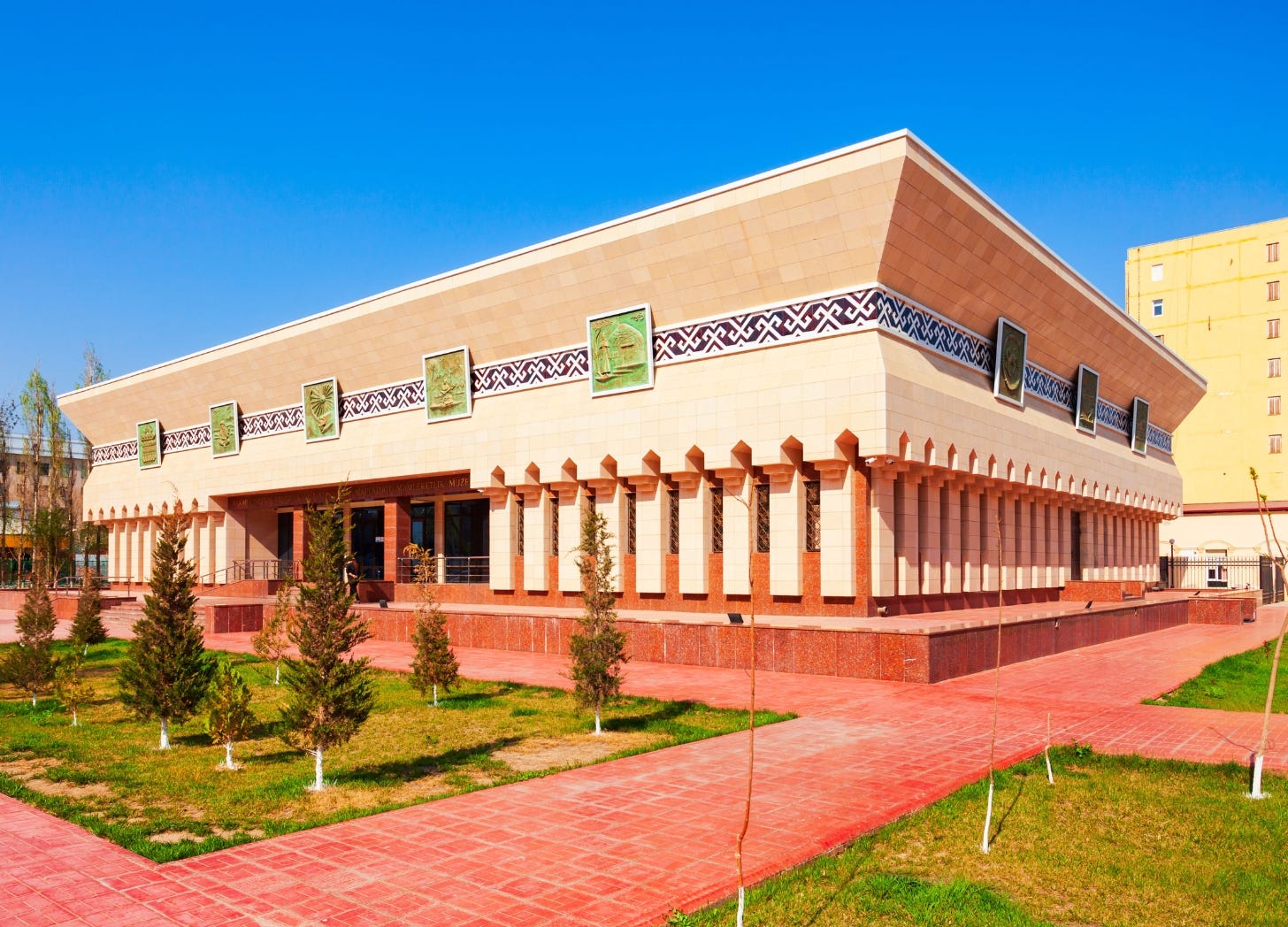
Reaching Nukus from almost anywhere in Uzbekistan is a trial, an unfortunate fact of life. If you are already in Urgench or Khiva, travel by road is feasible; otherwise, the rail and flight options are worth considering. There are two flights a day to Tashkent with Uzbekistan Airways (1 hour 40 minutes; from US50), with onward connections to domestic and international destinations, as well as flights to Moscow twice a week (3 hours 40 minutes; from US150). The airport, refurbished and expanded in 2018, sits 2km northeast of the city at the end of Dosnazarov, and bus number 15 runs the length of Dosnazarov from the train station to the airport.