

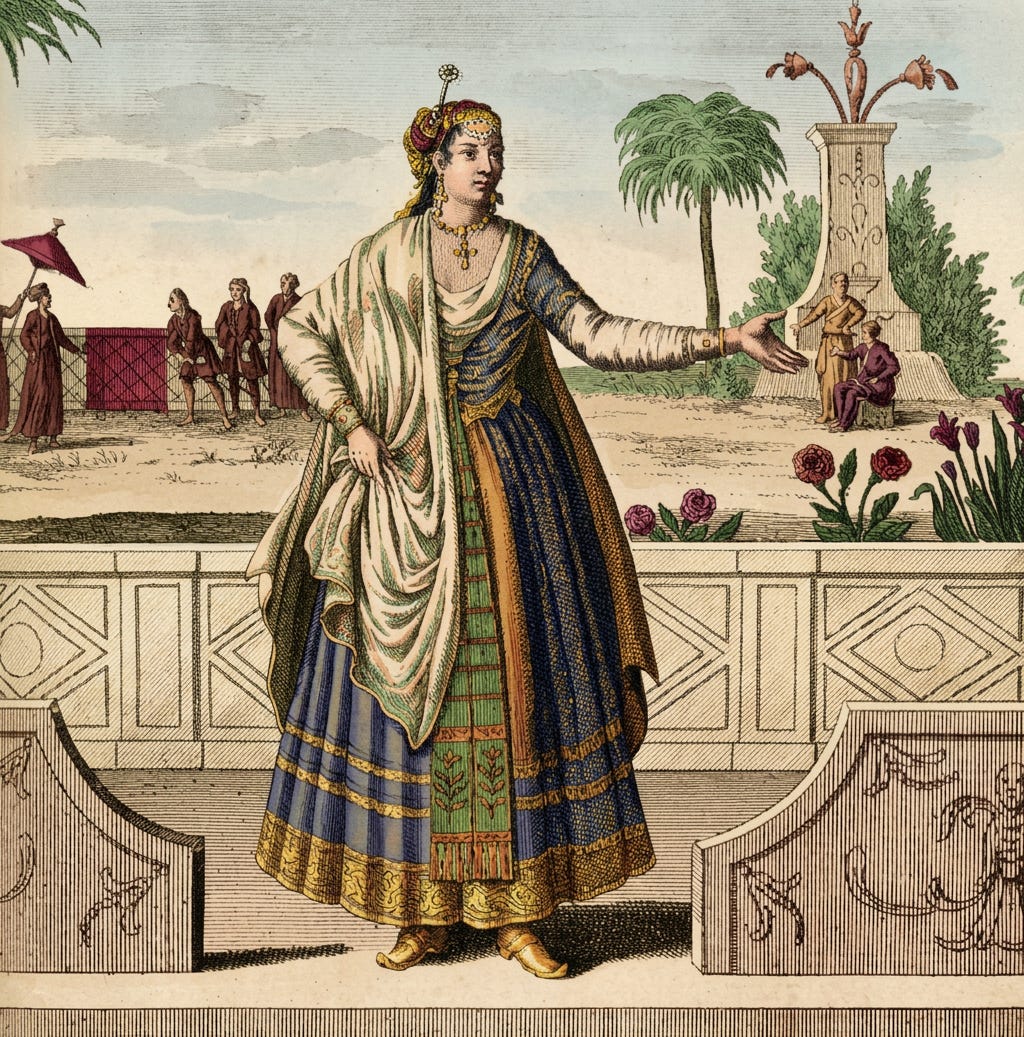
There is a signboard in Okhla, on the eastern edge of Delhi, that most travelers pass without a second glance. It reads “Sarai Julena Gaon,” and it is nearly all that remains, in stone and name, of a woman whose life once stretched like a golden thread between two of the mightiest powers the world had ever known. Her name was Juliana Dias da Costa, and to wander the dusty lanes that still murmur her memory is to step into a story so layered with fantasy and fragment that scholars have chased it across six languages and three centuries, through more than a hundred archival documents in Portuguese alone, and still more in Persian, Arabic, Urdu, Hindi, English, Dutch, French, Italian and German. She is a mystery pressed between the pages of empires, a legendary European lady and a Mughal prince, remembered in the very shape of a saga.
She was, we know for certain, of Portuguese descent, a Christian woman who moved through the marble courts of the Mughal emperors with a grace that startled everyone who set eyes upon her. She surfaces for the very first time as Juliana Dias da Costa in a Portuguese document sleeping in the oldest Historical Archives of Asia, in Goa, a single name rising from the deep well of the past. In Persian she appears only as a favourite of Bahadur Shah in the Tarikh-i-Muhammadi, but her true story unfolded beside Prince Shah Alam, the son of Aurangzeb who would rise to become Bahadur Shah the First. For more than forty-five years her fortunes were bound to his, and legend holds that she served him faithfully through seven long years of imprisonment, at the greatest peril to her own life, while the gruesome and bloodiest wars for the Peacock Throne thundered around them.
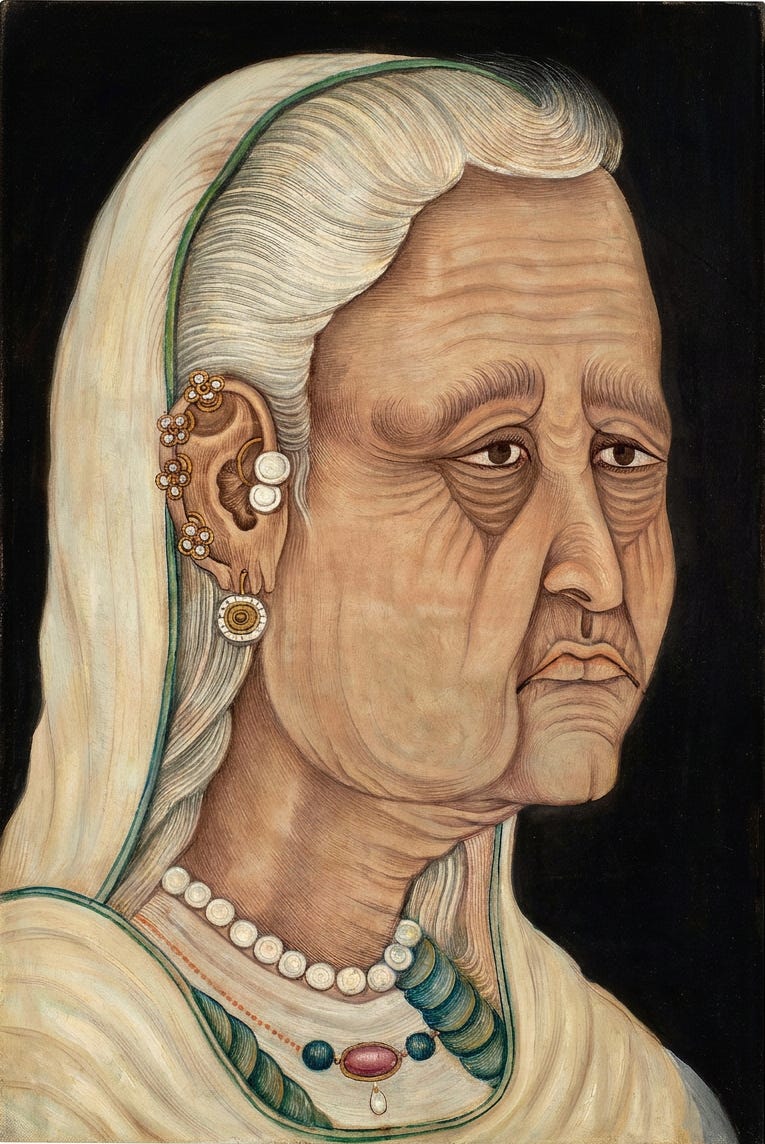
Her ascent was nothing short of phenomenal. In an age of intrigue she rose to the very summit of the richest court on earth, gathering titles and roles that would have seemed impossible for any woman, let alone a European Christian in a Mughal world. She was tutor to the princes and princesses, physician to the royal ladies, and Charge de Affairs of the harem, the royal table and the jewellery. She was a Jagirdar and a Mansabdar, an employer, a diplomat, and a Portuguese Ambassador. The court gave her many names, calling her Dona and Khanum, Madame de Maintenon and the Oracle of the Emperor, yet to the people she remained simply Bibi Julena. She lived in the finest mansion of the age, the very house once belonging to the doomed prince Dara Shikoh, and held a hoard of jewels and a Jagir of four villages in the vicinity of Delhi, with another, Manori, resting near distant Bombay.
It was through Juliana that the Estado da Índia, its influence quietly ebbing away like a receding tide, still found a living voice within a court where its own officials could no longer tread. When the Dutch Embassy arrived, it was she who received them with the strictest royal etiquette, customs and manners, and she who arranged a special concert of Dutch musicians whose violin, harp and hautboy charmed the Emperor and his queens, and the princes and the Amirs after them. The gifts that changed hands ran to over rupees thirty crores, and for her own people she secured a prize beyond price, the richest port of Surat, granted duty-free to the Portuguese.
The Portuguese crown did not forget her. Ennobled by the Mughal Emperor, she was honoured too by the Portuguese King, who granted her the highest distinction of nobility, the Habit of Christ, while the Pope himself blessed her grand services to Christianity. She was patroness of the Jesuit missions and mother, in spirit, to the Society of Jesus, benefactress of the College and Mission at Agra, and financier of the Jesuit mission sent across the high mountains to Tibet. In 1711 she set down her own hand in Persian, in a letter later rendered into Portuguese, praying for the glory of King João the Fifth and acknowledging the gifts that flowed between the Estado and the Mughal court. It is perhaps the only surviving whisper of her own voice, a single fragment among the many gathered from the past.
Yet for all her jewels and mansions, her villages and her titles, she is said to have remained down to earth in her manner of living. Her social welfare left behind a church and a sarai in Delhi, quiet monuments to a woman who bridged worlds. And when at last she longed to withdraw to the Santa Monica convent in Goa, the court, unwilling to lose her, pressed her to remain. Perhaps, in the end, she won her wish, and the Portuguese shore reclaimed her, drawing home at last the woman it had lent to history, a charismatic figure lost, for so long, in the mist of time.