

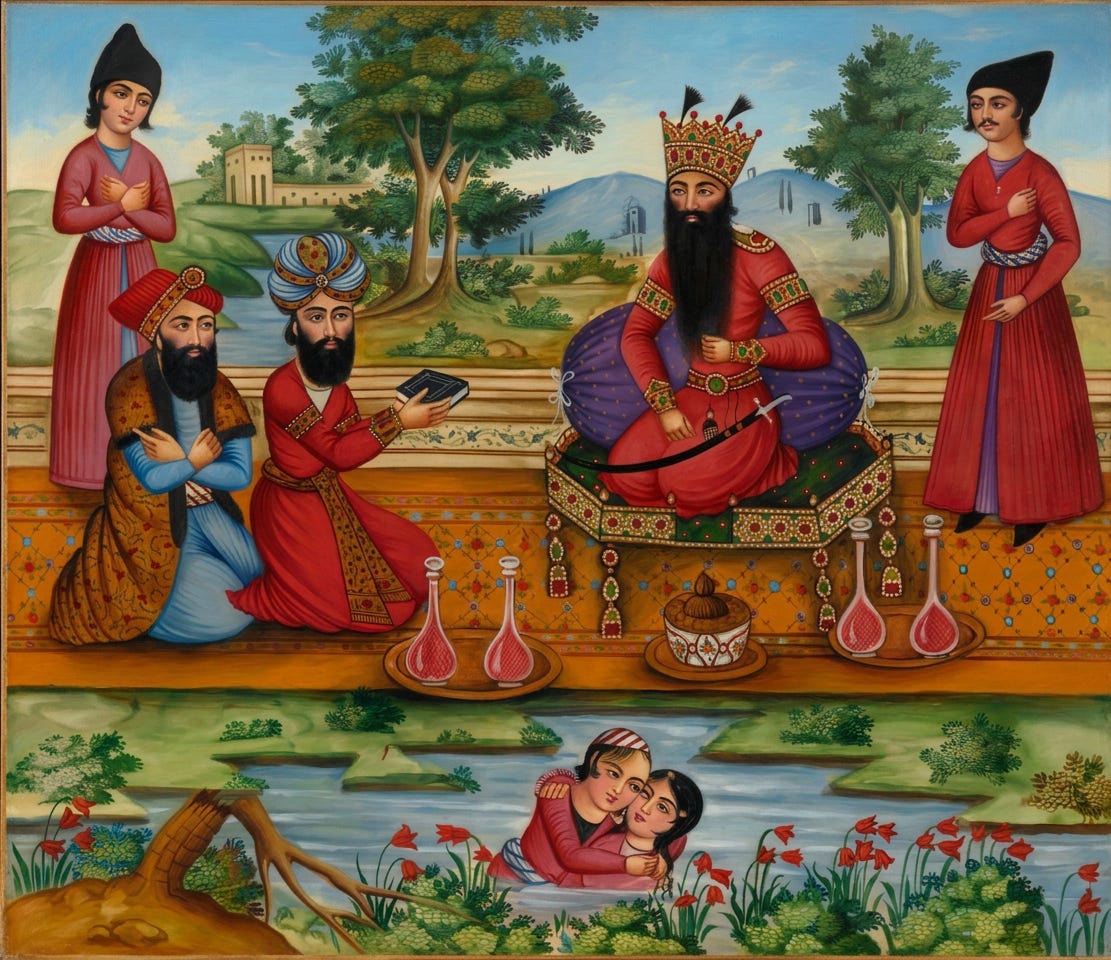
Fath-Ali Shah Qajar sits at the center of this 19th-century Qajar-era Persian painting, and everything in the frame was placed there on purpose. The long black bifurcated beard. The jeweled crown. The court attendants arranged around him like a carefully rehearsed ceremony. None of it was decoration, it was all political language, and it said one thing plainly: power lives here.
Fath-Ali Shah (r. 1797–1834), the second ruler of the Qajar dynasty, understood that a portrait could do more than capture a face. It could build an empire’s image. Court painters like Mihr ‘Ali produced whole cycles of these portraits, some of them close to 183 x 156 cm on canvas, sent abroad as diplomatic gifts at a time when Britain, France, and tsarist Russia were all circling Iran with very clear intentions.
But this particular painting carries something softer underneath all that ceremony. Down below the throne, a romantic pastoral scene unfolds, two figures most likely lovers, the kind who appear in old Persian poems. Ceremonial portraits for palace walls on one side, tender garden scenes for private rooms on the other. This painting holds both in one frame without needing to explain itself.
If you’re looking at Qajar court paintings for the first time, pay attention to what’s not centered. Those quieter details are usually where the real story sits.