

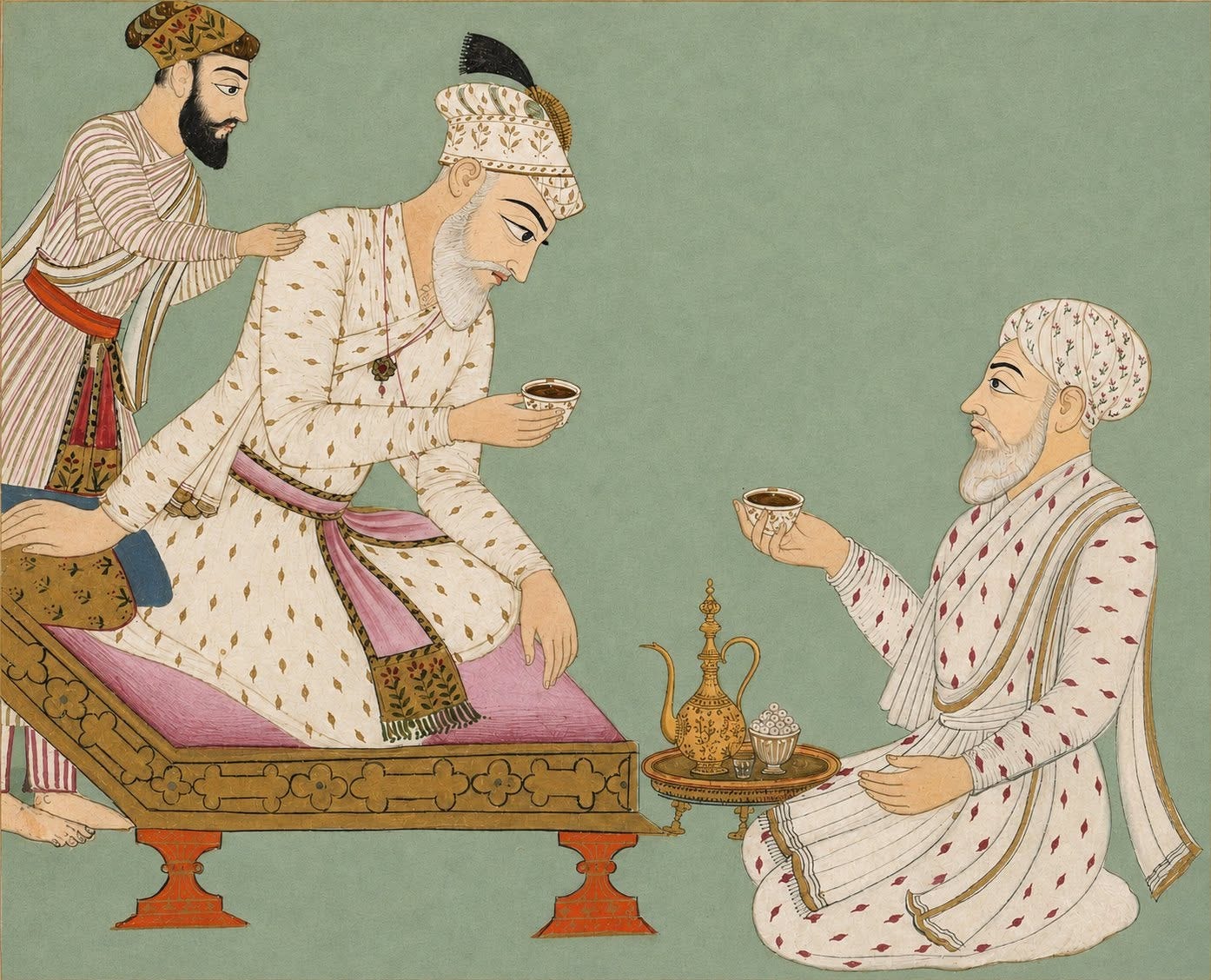
Among the many figures of the Mughal dynasty, Aurangzeb ‘Alamgir is remembered above all for his austerity—the pious emperor who abstained from wine in accordance with his faith. Yet the historical record preserves a quieter, more human habit: a genuine and lasting fondness for coffee. This detail, drawn from the daily bulletins of the Mughal court, offers a rare glimpse of the emperor’s private tastes and of the place coffee had come to occupy in the life of the palace.
The evidence rests on the akhbarat, the Mughal court news reports that recorded the routines and doings of the imperial household. The historian Munis D. Faruqui, whose 2026 study Aurangzeb ‘Alamgir and the Mughal Empire: A History Retold draws heavily on this archive, had already documented the emperor’s coffee-drinking in his earlier work, The Princes of the Mughal Empire, 1504–1719 (Cambridge, 2012). There, while reconstructing the morning routines of Mughal princes, Faruqui suggests that Aurangzeb likely acquired his taste for coffee during his first term as governor of the Deccan between 1636 and 1644.
Two specific court records anchor the claim. A 1695 entry in the Akhbarat-i Darbar-i Mu’alla (vol. 19, p. 462) shows Aurangzeb drinking coffee, and a 1705 report (vol. 30, p. 51) records the deputy-governor of Bijapur sending the emperor a gift of coffee beans. The dates are significant. By 1705 Aurangzeb was in his mid-eighties and still campaigning in the Deccan, the very region where he had first taken up the habit some seventy years earlier—evidence that this was no passing experiment of youth but a preference sustained across an entire lifetime. That a provincial official judged coffee beans a fitting gift for his sovereign suggests, too, that the emperor’s taste was well enough known at court to be relied upon.
Seen in this light, Aurangzeb’s coffee habit is more than a curiosity. Coffee had by the seventeenth century travelled from the highlands of Yemen through the ports of the Indian Ocean to become both a commodity of trade and a luxury of the court. In the single cup taken each morning by an aging emperor on a distant frontier, the wider geography of the early modern world and the intimate texture of one man’s daily life quietly meet.