

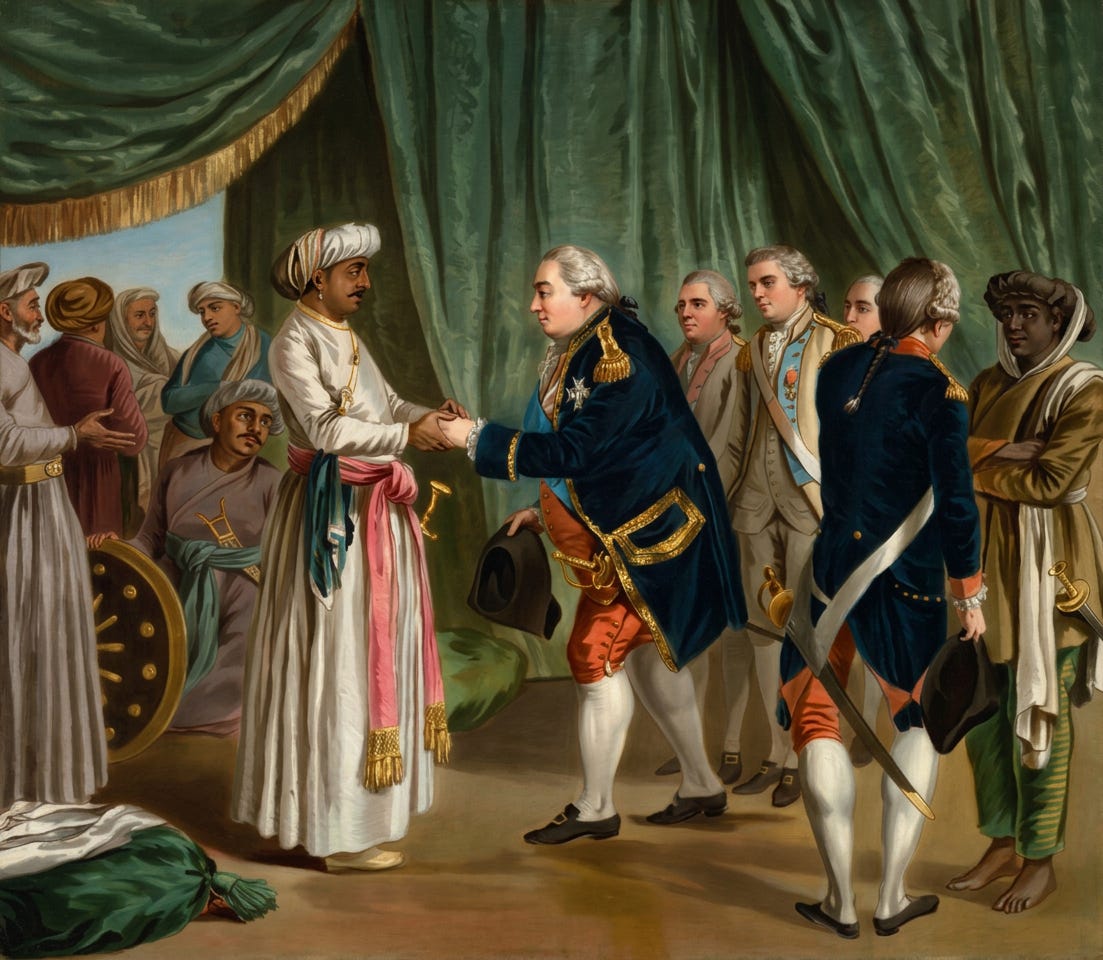
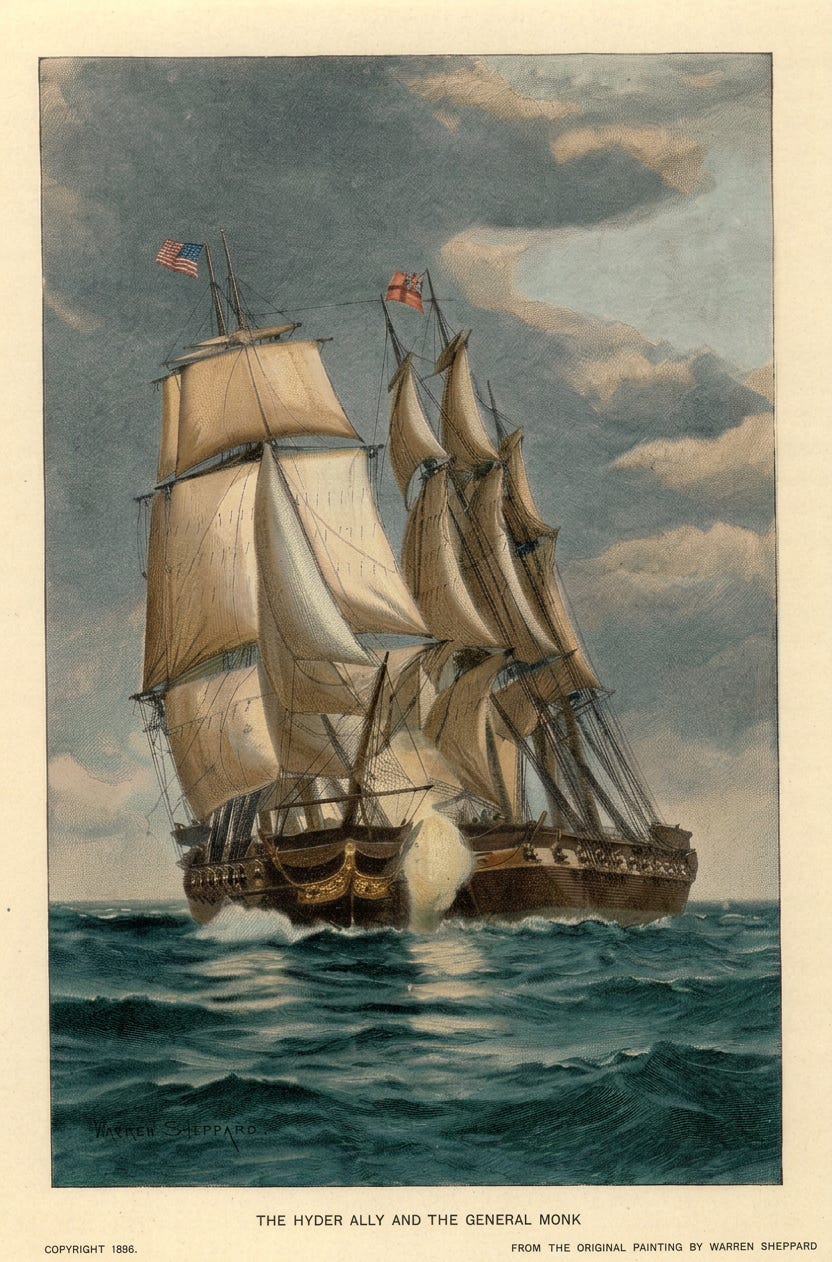
On the morning of April 8, 1782, dawn broke gold across the sheltered mouth of Delaware Bay, and a twenty-three-year-old lieutenant named Joshua Barney turned his lone sloop to face three approaching British warships. Above his deck, catching the first light, gleamed a name carried across oceans from a kingdom he would never see: the Hyder-Ally. It was a strange and wondrous thing, that a small hundred-ton merchantman, refitted with sixteen six-pounder guns to guard the commerce of Philadelphia, should bear the name of a Muslim sultan ruling the hills of southern India, half a world away.
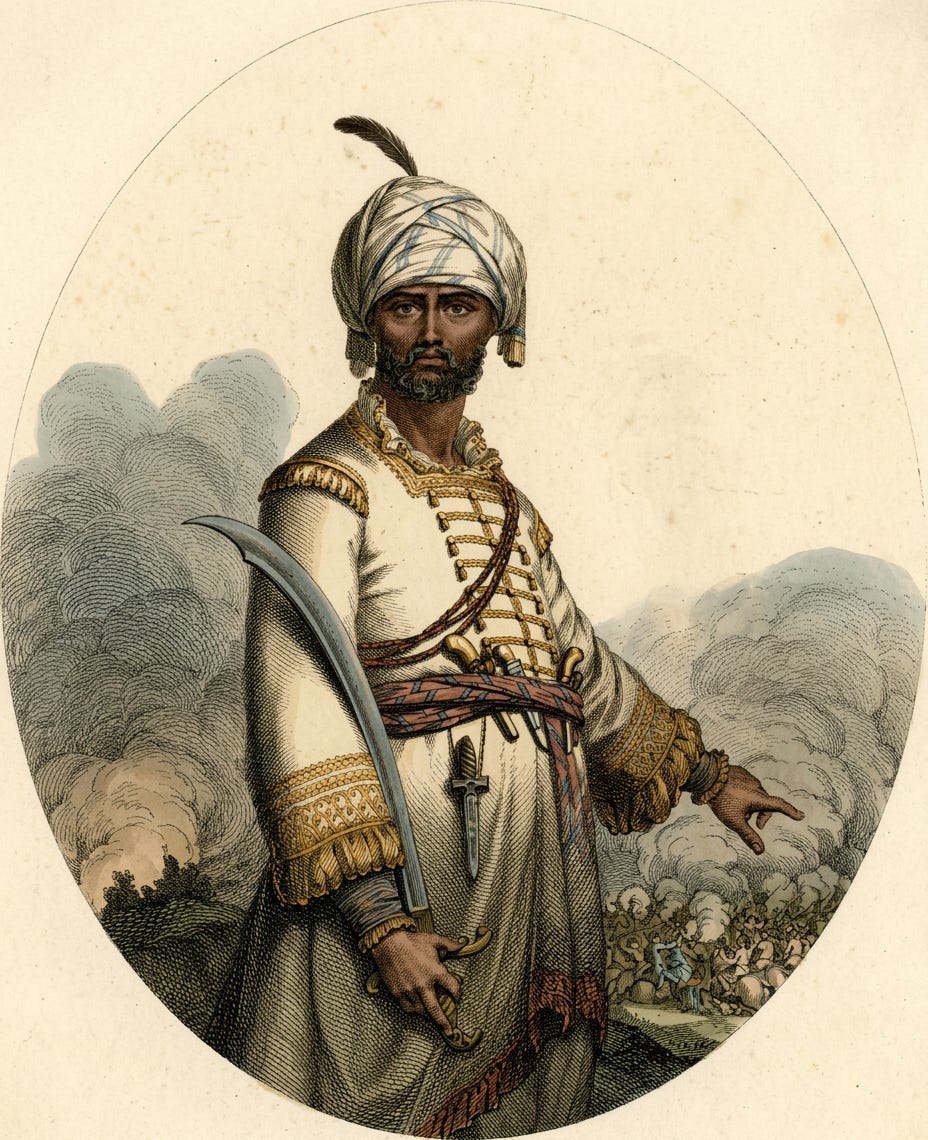
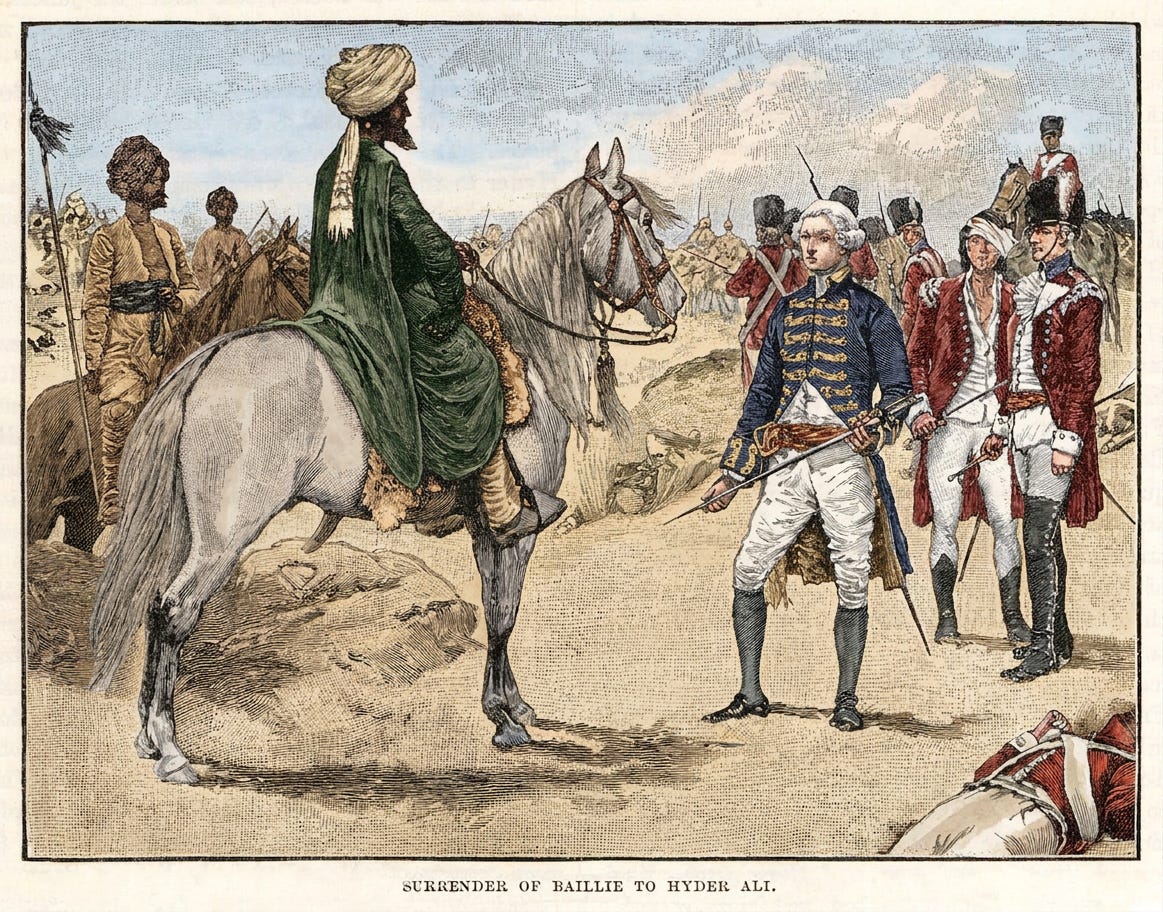
The name belonged to Haidar Ali, the formidable ruler of Mysore, whose gunpowder rockets had scorched the reputation of the British East India Company. In September 1780, at the Battle of Pollilur, Haidar Ali and his warrior son Tipu Sultan humbled British arms so thoroughly that the echo of it rolled across the Atlantic. To colonists rising against the same empire, Haidar Ali became a distant hero, linked to America through a shared ally in France. When Cornwallis surrendered to Washington at Yorktown in October 1781, a celebration nine days later at Trenton, New Jersey, raised thirteen toasts amid the thunder of artillery, one of them lifted to “the great and heroic Hyder Ali, raised up by Providence to avenge the numberless cruelties perpetrated by the English.”
So it was that when Pennsylvania fitted out that sloop, they christened her for the eastern prince. To fill her decks, Barney turned to a recruiting poem by Philip Freneau, its verses summoning young men to sail “in the Hyder Ali privateer,” a ship named for a ruler “who, smit with freedom’s sacred flame, usurping Britons brought to shame.” Within an astonishing fourteen days, Barney had recruited and trained roughly a hundred and ten men and readied the ship for war.
The battle that followed became legend. Ordering his merchant convoy to flee up the shallow channel, Barney held his fire until the eighteen-gun General Monk drew close, then bellowed a false command by “the rule of the contrary” that sent the British ship tangling helplessly into his rigging. For twenty-six blistering minutes the two vessels traded broadsides at pistol range, grapeshot shrieking through canvas and cordage. When the smoke cleared, the General Monk had struck her colors, having lost twenty men killed and thirty-three wounded, including nearly every officer aboard, while the Hyder-Ally counted four dead. Philadelphia erupted in ballads sung through the streets, and the Legislature awarded Barney a gold-hilted sword bearing images of both ships.
The bonds ran deeper than a christening, for Tipu Sultan himself, upon hearing of the Declaration of Independence, wrote that “every blow that is struck in the cause of American liberty throughout the world, in France, India, and elsewhere... the struggle shall continue.” A painting of the Hyder-Ally’s triumph, commissioned by Barney in Paris, hangs still at Annapolis, a quiet witness to the day an Indian king’s name blazed brightest upon American seas.